
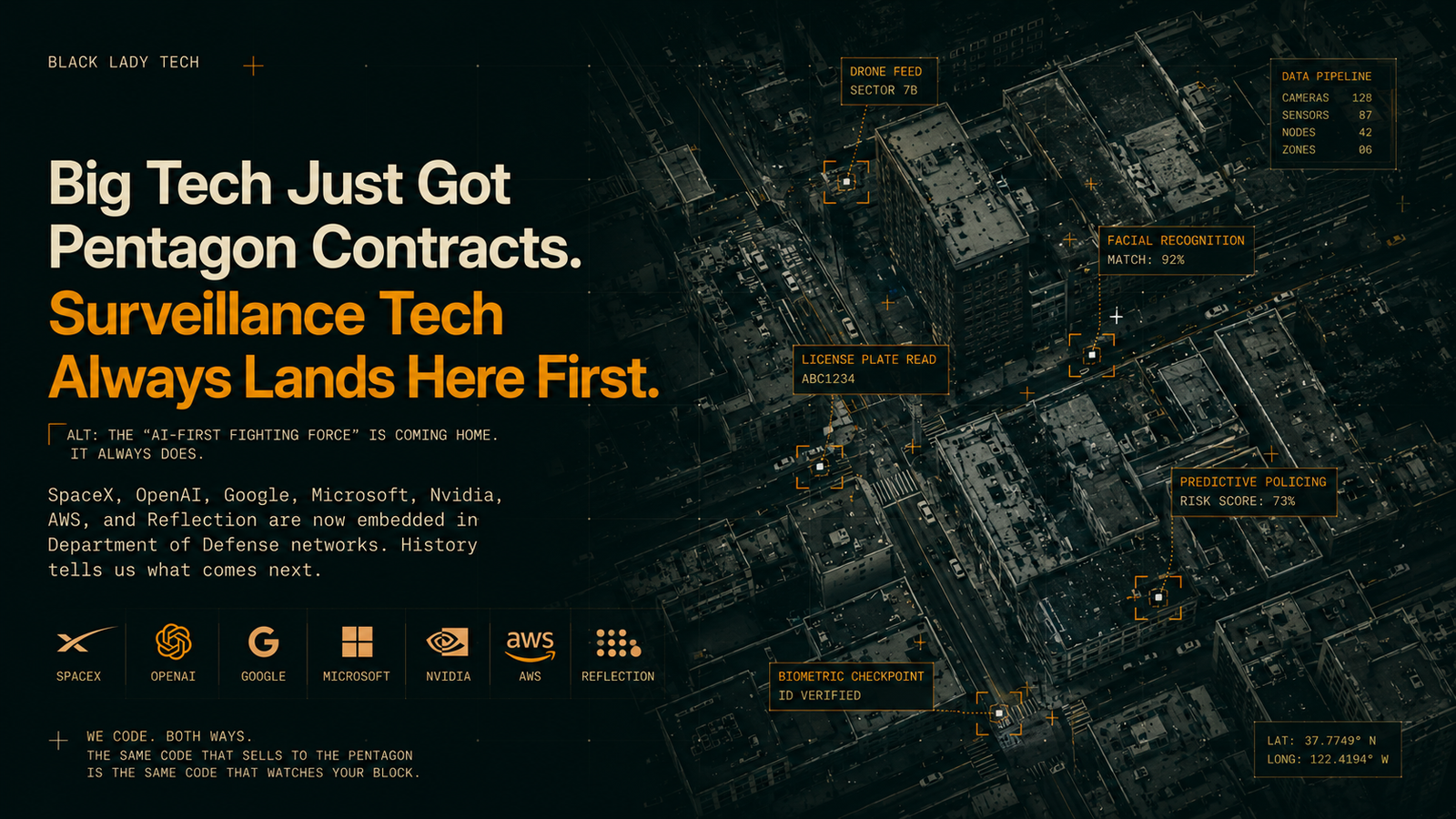
When the Department of Defense says it wants an “AI-first fighting force,” that is the line everyone hears. What people are not hearing: the surveillance tools that get built for foreign war zones are the same tools that come home. They always come home. And they always land in Black neighborhoods first.
Now, who has contracts: the DoD announced agreements with several Big Tech companies to deploy AI tools inside classified networks, including OpenAI, Google, Microsoft, Amazon Web Services, Nvidia, SpaceX, and Reflection AI [1]. Public reporting also noted that Anthropic was not part of the deal after it reportedly refused broader military-use terms [2].
What this actually means on the ground: AI surveillance technology has a track record. Facial recognition misidentifies Black people at significantly higher rates than white people, a pattern researchers like Joy Buolamwini have been documenting for years [3]. Predictive policing algorithms have repeatedly been shown to reinforce existing policing patterns in Black and brown neighborhoods [3]. License plate readers, biometric checkpoints, drone surveillance. Every tool that gets developed for “the battlefield” eventually shows up on a city street. Often the same street.
The money flow to track: government contracts are public records. So are board members. So are political donations. The same names keep showing up. The tech sector and the defense sector are increasingly intertwined, which makes the influence network harder to ignore [4].
Historical analog: COINTELPRO. The infrastructure built to surveil “foreign threats” was the same infrastructure used to surveil civil rights leaders, Black Panther organizers, and Black student movements. The pattern is older than any of these companies. The tech is just faster.
Why it matters now: the contracts are getting signed. Tools are being built. There is no big public vote on whether AI should be embedded in classified defense networks. It is already happening. The window for “should this be a thing” closed a while ago. The window now is who gets oversight, what gets exported back to domestic policing, and who is in the rooms where this is decided.
We code. Both ways. The same code that sells to the Pentagon is the same code that watches your block.