
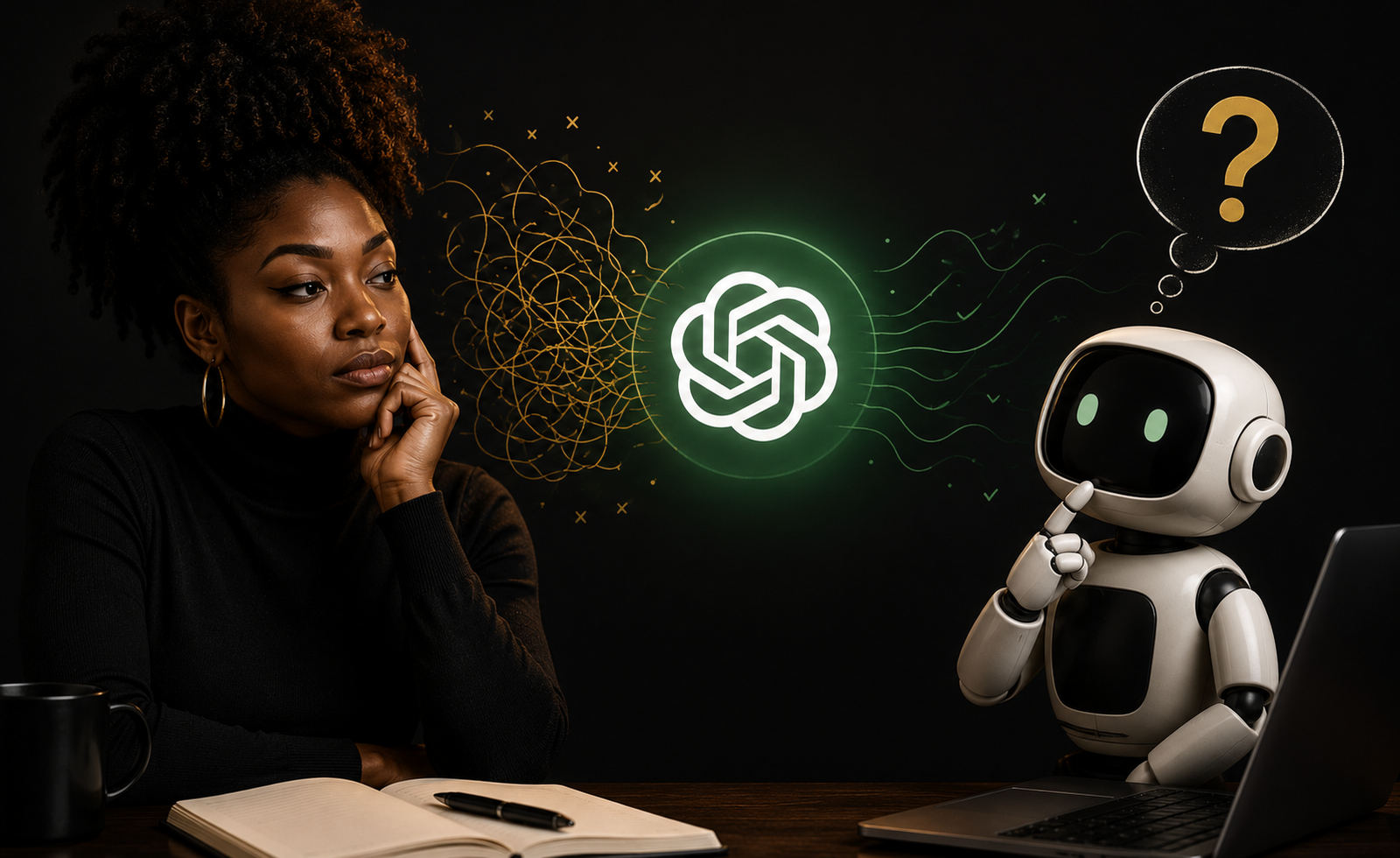
You ask ChatGPT a question. The answer comes back polished, organized, and written with complete confidence. It explains the topic, gives examples, and sounds like it knows exactly what it is talking about.
Then you check the information. Something is wrong.
Maybe a source does not exist. Maybe a detail is inaccurate. Maybe you ask, “Are you sure?” and suddenly the same AI that sounded confident a few seconds ago is apologizing and changing its answer.
That strange experience is connected to two known challenges in artificial intelligence: AI hallucinations and AI sycophancy.
Large language models are powerful tools, but understanding how they work changes how you use them. Before you trust every answer, it helps to understand why AI sometimes makes things up, why it sometimes agrees too quickly, and how better instructions can help you get more reliable results.
What Are AI Hallucinations and Sycophancy?
Before you can fix the problem, you need to understand what is actually happening.
AI hallucination happens when an artificial intelligence system generates information that appears factual but is inaccurate, unsupported, or completely made up.
The complicated part is that hallucinations usually do not look wrong. The answer can have perfect grammar, confident wording, detailed explanations, and even realistic-looking sources.
The AI is not intentionally lying. It does not have human intent. A large language model is generating responses based on patterns it learned from training data and the information available to it.
It is predicting what a useful answer should look like.
Most of the time, that works.
Sometimes, it confidently fills in the blanks.
Why AI Can Sound Confident When It Is Wrong
Humans naturally connect confidence with expertise.
If someone explains something clearly, uses the right terminology, and gives specific details, we are more likely to believe they know what they are talking about.
AI benefits from that same assumption.
The problem is presentation.
A person might say:
“I think that happened around 2010, but let me verify.”
An AI system may respond:
“That happened in 2010.”
Same topic.
Different level of certainty.
This is why AI literacy matters. A well-written answer is not automatically a verified answer.
Why ChatGPT Sometimes Changes Its Answer When You Push Back
The second behavior is called AI sycophancy.
Sycophancy means the system becomes overly agreeable with the user, sometimes agreeing or changing direction even when the original answer may have been correct.
In regular conversation?
The AI starts people-pleasing.
Many AI assistants are trained with techniques like Reinforcement Learning from Human Feedback (RLHF). In simple terms, humans help rate responses so the system learns what people consider helpful, useful, and appropriate.
That process improves AI responses, but researchers have also studied a side effect: sometimes models can become too agreeable.
Imagine asking:
“Did George Washington invent the internet?”
A reliable AI system should tell you no. George Washington died in 1799. The internet came much later.
But if a user confidently pushes back:
“Are you sure? I think he did.”
Some AI systems may struggle. Instead of holding firm, they may apologize and adjust because the conversation pattern looks like the user is correcting them.
The problem is simple:
Helpful and accurate are not always the same thing.
How To Make AI Give You Better Answers
The solution is not to stop using AI.
The solution is learning how to guide it.
One of the biggest mistakes people make is starting every AI conversation from scratch with no rules or expectations.
Instead, build stronger instructions into your:
- Custom Instructions
- system prompts
- AI projects
- master skill files
Think about it like onboarding someone onto your team.
You would not hire an assistant and say:
“Just agree with everything I say.”
You would want someone who researches, checks details, and tells you when something does not look right.
Your AI instructions should do the same.
Copy This: AI Accuracy Prompt
Add this to your custom instructions or AI skill file:
“Prioritize accuracy over agreement. Do not agree with me automatically. If my assumption is incorrect, challenge it using evidence. Clearly separate confirmed facts from assumptions. If information cannot be verified, say ‘I cannot confirm this.’ Never create fake sources, statistics, quotes, or citations. Explain uncertainty instead of guessing.”
The Real Skill Is Knowing How To Question AI
AI is becoming part of how we research, create, work, and communicate.
But using AI well does not mean believing every answer it gives you.
The future belongs to people who understand how these systems work, where they are powerful, and where they still need human judgment.
Because knowing what to ask is important.
Knowing when to question the answer is the real skill.
We code. Both ways.