
You’ve probably seen it floating around tech Twitter. Somebody in a LinkedIn comment said you need it. A developer on Reddit swears it changed their traffic. And now you’re wondering if your site is falling behind because you don’t have one.
Let’s talk about llms.txt: what it actually is, why brands are scrambling to add it, and what the data actually says.
So What Is It?
llms.txt is a proposed standard, emphasis on proposed, where you drop a markdown file at the root of your website. Think yoursite.com/llms.txt. The idea is to help AI systems understand what your site is about, where the important pages live, and what content is approved for AI use.
Same basic concept as robots.txt, but marketed for the AI era.
In theory: you write a clean, structured file, ChatGPT reads it, and suddenly your brand is getting cited everywhere.
In theory.
Why Brands Are Adding It
The fear of being invisible to AI is real. As more people use ChatGPT, Perplexity, Claude, Gemini, and AI search tools to find answers instead of typing everything into Google, brands are asking a fair question: does AI even know we exist?
llms.txt looked like the answer. A quick file, a few lines of markdown, and your site gets the AI stamp of approval. Easy. Cheap. Low-lift.
That logic is understandable. It is also not backed by strong evidence yet.
What the Data Says
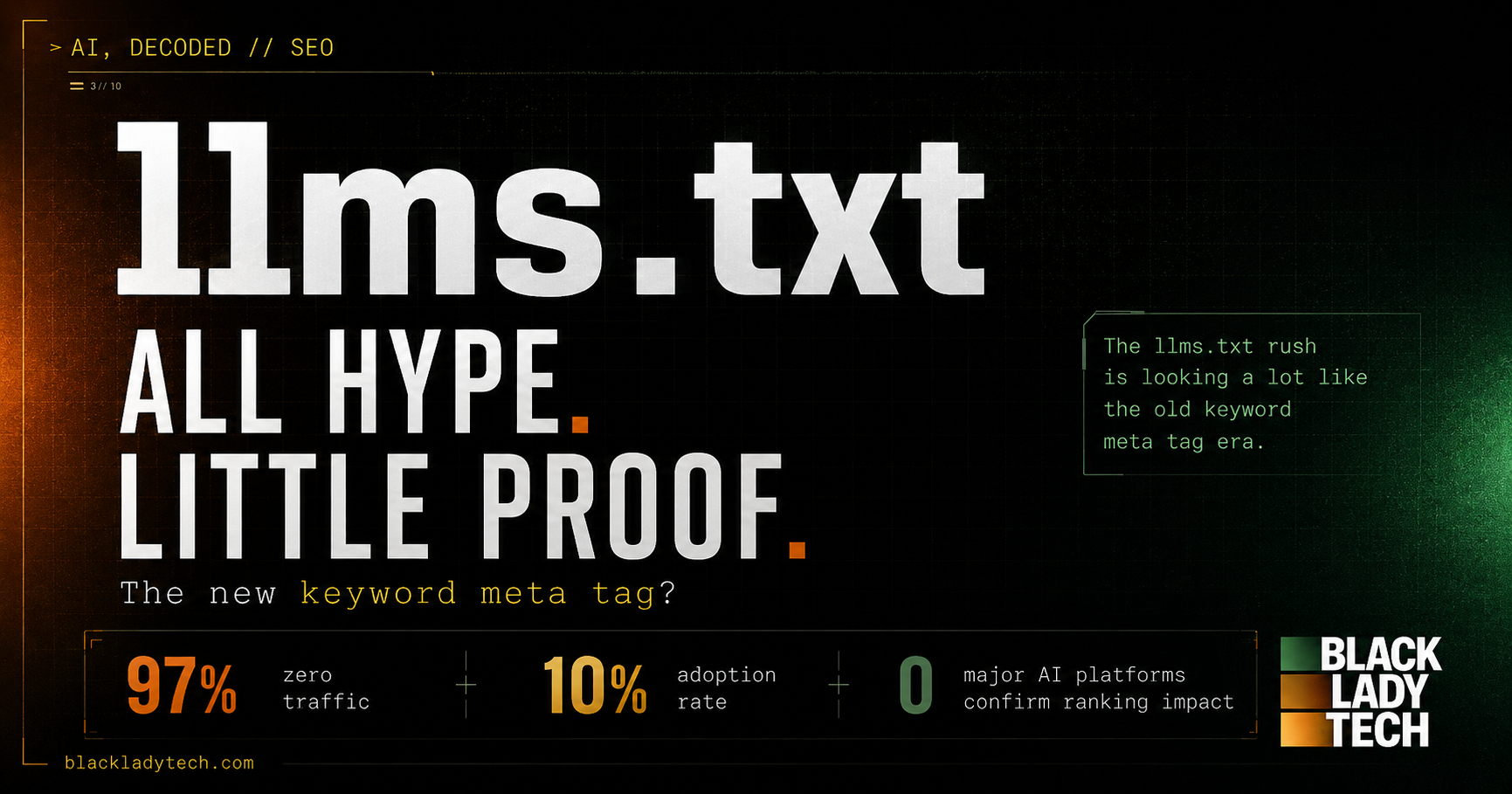
SE Ranking studied nearly 300,000 domains and found that only about 10% had implemented llms.txt. That adoption number is interesting, but the more important finding is what happened when researchers tested whether the file actually helped predict AI citations.
SE Ranking ran a machine learning analysis using XGBoost to see whether having llms.txt correlated with how often a site got cited by AI tools. The result: removing the llms.txt variable improved the model’s accuracy. In plain English, the file was not helping explain citations. It was noise.
Ahrefs ran its own study across 137,210 domains in Ahrefs Web Analytics that received traffic in May 2026. Of the sites with valid llms.txt files, 97% received zero requests for that file during the study period.
Zero.
That does not mean llms.txt can never become useful. It means the current evidence does not support the hype.
What Google Said Directly
Google’s own guidance is pretty plain: you do not need to create new machine-readable files, AI text files, markup, or markdown files to appear in Google Search, including its generative AI features. Google says Search itself does not use llms.txt in a special way.
That matters because a lot of the llms.txt pitch sounds like old-school SEO panic with a new outfit on. It has the same energy as the keyword meta tag era, when people believed stuffing a hidden field with phrases would magically move them up in search.
The problem is the same: a file where you declare yourself important is not the same thing as earning visibility.
The Platforms Haven’t Confirmed It Matters
Here is the part that gets skipped in the hype: major AI and search platforms have not publicly confirmed that llms.txt improves rankings, citations, or retrieval.
OpenAI has not confirmed that llms.txt affects how ChatGPT ranks or cites anything. Anthropic has not confirmed it for Claude. Perplexity has not confirmed it either. Google’s AI search guidance points site owners back to established search fundamentals, not special AI files.
Chrome Lighthouse does include an llms.txt check for agentic browsing contexts, but that is not the same as saying the file improves rankings, traffic, or AI citations. A missing file is not treated like a penalty.
Translation: this may become useful infrastructure one day. Right now, it is not a proven visibility strategy.
What Actually Works
If you want AI systems and search tools to find, understand, and cite your content, the foundation has not changed.
Crawlability. If bots cannot access your content, no file at your root is fixing that.
Semantic HTML. AI systems read structure. Use headers. Use proper markup. Make your content make sense to a machine and a person.
Structured data. Schema markup gives search systems context that a markdown file at the root simply cannot replace.
Accessibility. Content that works for screen readers is usually easier for machines to parse too. Same principle.
Substance. AI tools cite sources that appear useful, authoritative, and relevant. Write content that earns a citation. Do not try to game your way into one.
Google’s current guidance is boring on purpose: make your content crawlable, useful, and easy to understand. That is not sexy, but it is still the work.
The Bottom Line
llms.txt is not harmful. If you want to add it, fine. It is low-risk and low-lift.
But building a strategy around it and expecting measurable AI visibility gains? That is spending energy on a proposal major platforms have not confirmed as a ranking or citation factor.
Your time is better spent on content that is genuinely useful, technically sound, accessible, structured, and actually crawlable. That is what gets found. That is what gets cited.
We do not chase every new file format that tech Twitter says will change the game.
We build things that work.
WE CODE. BOTH WAYS.